Contents
The Silent Death of Orphan Data Pipelines
🌳 High Hanging Fruit
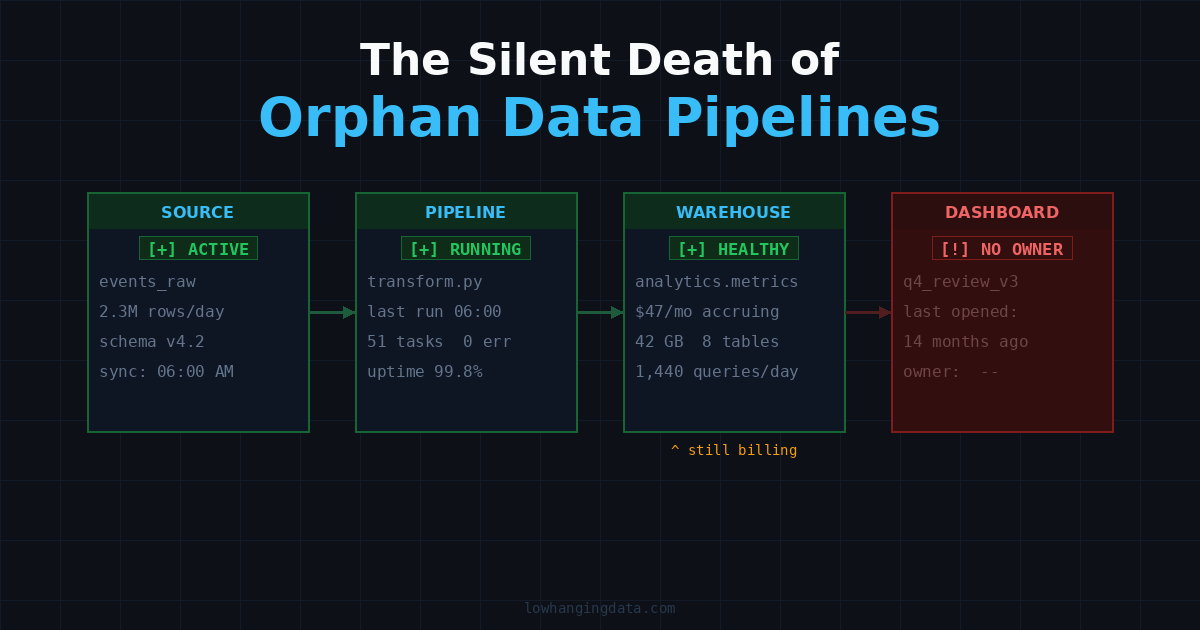
A dashboard that was the centerpiece of a quarterly business review eighteen months ago sits unused today. The underlying Snowflake query still executes on schedule. The Airflow DAG still logs successful runs. The warehouse bill still arrives. The stakeholders who commissioned the product have stopped trusting the output — not because of a specific failure, but because the numbers no longer align with their operating reality. That divergence has not been communicated explicitly, and the pipeline has no mechanism to detect it.
This is the default trajectory of a data product decoupled from the business process it was built to serve. It is the dominant pattern across most enterprise data estates.
The Decay Is Not Technical — It Is Temporal
The common assumption is that a data product fails when the pipeline breaks. The more frequent failure is subtler: the pipeline continues to run, but the product’s relevance to the business decays from the moment active engagement stops. The mechanism is specific. Business definitions shift — the definition of “active user” gets revised, the company’s revenue attribution model changes, a new market segment is added that breaks a geographic assumption in the query. These changes are not captured in a schema migration. They accumulate in the gap between how the business has evolved and how the data product was originally constructed to describe it.
Upstream schema changes compound this. A source table gains a new nullable column. A join key migrates from integer to UUID during a backend refactor. A field that previously contained null is now populated with a sentinel value that alters aggregation behavior. None of these events trigger an alert. The pipeline adapts silently, producing outputs that diverge from their original meaning — outputs that remain plausible until the divergence becomes substantial enough to be obvious.
The result is definitional drift: a metric that exists, has a name, and returns a value, but no longer measures what the business intends to measure. Drift is harder to detect than a pipeline failure and more costly. A broken pipeline produces no output. A drifted metric produces an authoritative-looking output that no one is validating against operational reality.
Timeliness Is Not the Same as Pipeline Freshness
Organizations frequently conflate the two. A pipeline that refreshes hourly is considered timely. But timeliness, in the business sense, means the alignment between what the data product reports and what is actually true in the business today. A pipeline can run every hour and still produce data that is fundamentally stale — stale in its definitions, stale in its context, stale in the business question it was built to answer.
The only mechanism that maintains alignment is active engagement. When a stakeholder is required to act on a data product at a regular cadence, they notice when it diverges from operational reality. They raise the question of why the churn figure differs from what the account team is reporting. They flag that the definition of “qualified lead” changed in Q3 while the dashboard still uses the prior criteria. That ongoing scrutiny functions as a continuous calibration process. Without it, no calibration happens and the product drifts without a feedback loop to surface the problem.
Engagement is therefore not a usage metric — it is a maintenance protocol. The recurring consumer is not only the beneficiary of the data product; they are the mechanism by which the product remains accurate. A weekly operations review that depends on a specific output will surface a broken metric within one reporting cycle. A pipeline with no active consumer can operate incorrectly for six months before the divergence is detected.
The Economics of an Orphaned Data Product
An unused data product is not a neutral asset. It is an active liability with three compounding cost vectors.
The first is direct infrastructure cost. Compute and storage charges accrue whether or not the output is consumed. A single mid-sized pipeline running nightly on a cloud data warehouse carries a real monthly cost. Across a typical enterprise data estate, where orphaned pipelines are the norm rather than the exception, these costs aggregate quickly — often without Finance or Engineering having a clear view of which pipelines are serving active use cases and which are not.
The second is the cost of false confidence. An active data product with engaged consumers generates questions, corrections, and refinements. An orphaned product generates none of these, so errors accumulate without correction. If the product is consulted for a one-off decision — and orphaned products often are, precisely because they appear to exist and be authoritative — the business is making that decision on unchecked, potentially drifted data. The pipeline ran clean. The output may not be right.
The third is organizational trust. Stakeholders who quietly stop trusting a data product do not typically announce this. They route around it: commissioning new analyses, relying on judgment over data, or building parallel reporting that confirms their intuitions. By the time the trust gap surfaces explicitly, the data team has a credibility problem with no clear origin point and no obvious path back.
Making Engagement a Prerequisite, Not a Hope
Before any new data product is commissioned, three questions require explicit answers: What specific business decision does this output feed? Who is accountable for reviewing it, and on what cadence? What is the escalation path when the output appears inconsistent with operational reality? These are not governance formalities. They are the conditions under which the product can remain valuable over time.
If the answers are vague at kickoff — if the expected value is “useful in general” rather than essential to a specific decision — the product will not hold its value. Data that is not actively engaged with does not remain relevant. It drifts toward the state of every other orphaned pipeline in the estate: running, billing, and no longer aligned with business reality. The pipeline is the easy part. Keeping the output aligned with the business requires an owner, a cadence, and an organizational commitment to treat the data product as an ongoing obligation rather than a completed deliverable.
A data product without an owner is not infrastructure. It is a recurring invoice for work that has stopped producing value.