Contents
Trust and Time Are the Real Currencies of Data ROI
🍎 Low Hanging Fruit
There is a version of the data ROI conversation that skips the most important part. It goes straight to dashboards, models, KPIs, and automation — the outputs — without addressing the thing that makes any of those outputs worth anything: whether anyone trusts the numbers.
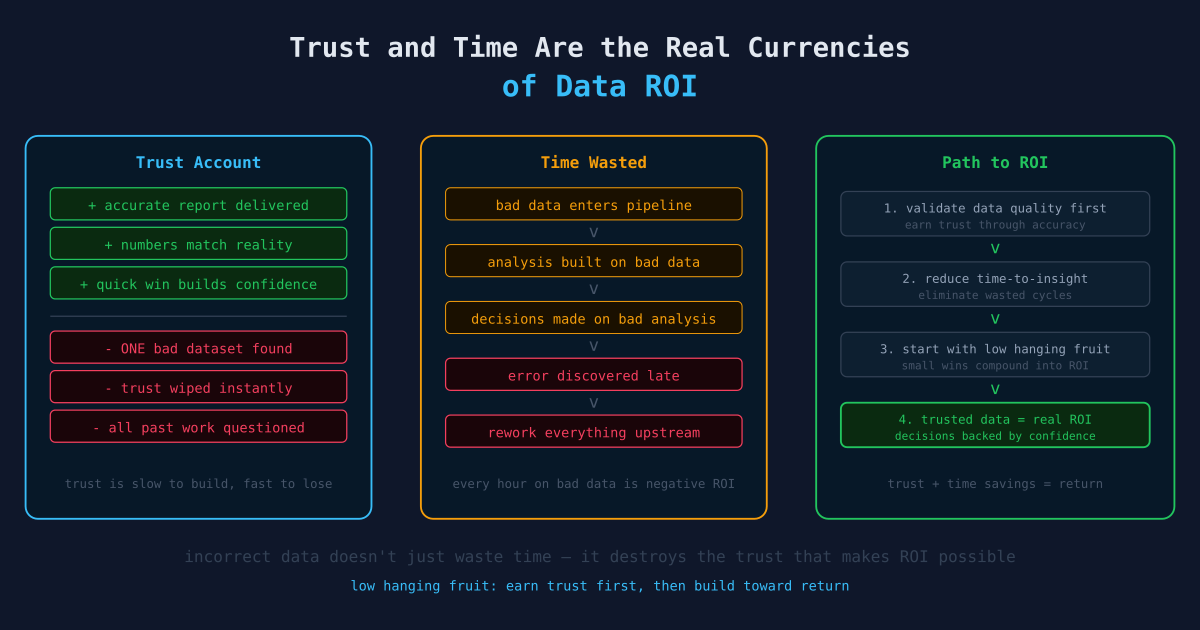
Trust is not a soft metric. It is a resource. It is finite, slow to accumulate, and fast to destroy. And when it is gone, everything built on top of it — every report, every dashboard, every recommendation — becomes suspect. Not just the thing that was wrong. Everything.
Time is the other resource. Every hour a team spends working with incorrect data is an hour that produces negative value. It is not zero. It is negative. Because the work still gets done, decisions still get made, and when the error surfaces — and it always surfaces — the rework cost is the original time plus the cost of unwinding whatever happened downstream.
If data analytics cannot protect these two resources, it will not generate a return. Full stop.
How Trust Gets Destroyed
Trust in data does not erode gradually. It collapses.
A stakeholder reviews a report and notices a number that does not match what they know to be true. Maybe revenue for their region is off by 15%. Maybe a customer count includes test accounts. Maybe a metric changed definition between two reports and nobody flagged it.
In that moment, the stakeholder does not think “this particular number is wrong.” They think “I cannot trust these numbers.” The distinction matters enormously. A single data error does not just invalidate one data point — it invalidates the entire system that produced it.
This is not irrational. It is a perfectly reasonable heuristic. If one number is wrong and nobody caught it, what else is wrong that nobody has caught? The stakeholder cannot verify every number in every report. They were relying on the data team to do that. That reliance just broke.
The recovery path is long. One accurate report does not restore trust. Ten might not. The stakeholder will check your numbers against their own for months. They will mention the error in meetings. They will hedge when citing your work. They will build their own spreadsheet “just to be safe.”
All of that is rational behavior from someone whose trust was broken. And all of it is overhead that did not exist before the error.
How Time Gets Wasted
The time cost of bad data is not limited to the moment the error is found. It cascades.
The initial work is wasted. Whatever analysis was built on the incorrect data has to be redone. Not adjusted — redone. Because once you know the input was wrong, you cannot be confident about which parts of the output are affected and which are not. The safe move is to start over.
The investigation is expensive. Finding the root cause of a data error is often harder than the original analysis. Was it a source system issue? A transformation bug? A schema change that was not propagated? A join that silently dropped rows? Tracing the lineage takes time, and the people doing it are the same people who should be doing new work.
Downstream decisions may need to be revisited. If someone made a business decision based on analysis that was based on bad data, that decision is now in question. Depending on the stakes, this can range from an awkward correction to a genuinely costly reversal.
Future work slows down. After a data error, every subsequent analysis carries an implicit overhead: extra validation, extra spot-checking, extra time spent convincing stakeholders that this time the numbers are right. This overhead is invisible in project plans but very real in elapsed time.
The compounding effect is what makes bad data so expensive. A single incorrect field in a source table does not just waste the five minutes it takes to fix the field. It wastes every hour of every person who touched anything downstream before the error was caught.
Time and Trust as Resources
The ROI conversation for data analytics usually focuses on what the analytics produce: better decisions, faster reporting, operational efficiency, revenue attribution. Those are real outcomes. But they are downstream of something more fundamental.
Time is the input. Every data initiative requires time from analysts, engineers, stakeholders, and decision-makers. The question is whether that time produces value or waste. When the data is correct and the analysis is sound, time converts into insight. When the data is wrong, time converts into rework, investigation, and damage control.
Trust is the multiplier. A well-built dashboard that nobody trusts has zero effective value. A simple report that a VP trusts enough to cite in a board meeting has enormous value. The same analytical output, multiplied by different levels of trust, produces wildly different returns.
This framing changes how you think about ROI:
| Low Trust | High Trust | |
|---|---|---|
| Good Analysis | Ignored or double-checked | Acted on confidently |
| Bad Analysis | Confirms suspicion, erodes further | Causes damage, destroys trust |
The upper-right quadrant — good analysis delivered in a high-trust context — is the only one that generates real ROI. Every other quadrant is either waste or active harm.
Why ROI Plans Require Trust First
You cannot build a credible ROI case for data analytics in a low-trust environment. The math does not work.
An ROI case says: “If we invest X in data capabilities, we will get Y in return.” That claim requires the audience to believe several things:
- The data will be correct. If the audience has seen incorrect data from your team, they will not believe this.
- The analysis will be sound. If past analyses have been questioned or contradicted, they will not believe this either.
- The recommendations will be actionable. If previous deliverables sat unused, this claim rings hollow.
- The timeline is realistic. If past projects overran, the proposed timeline has no credibility.
Each of these beliefs is a trust deposit. If the account is empty, the ROI case — no matter how well-constructed — will not be funded. Or it will be funded at a fraction of what it needs, with excessive oversight, which often produces exactly the underpowered result that confirms the skepticism.
This is the trap that many data teams find themselves in: they need investment to produce results, but they need results to earn the trust that unlocks investment. The cycle has to be broken somewhere.
Breaking the Cycle with Low Hanging Fruit
This is where low hanging fruit stops being a consolation prize and becomes a strategy.
Low-hanging fruit projects share a set of properties that make them uniquely suited to building trust and protecting time:
They are small enough to validate thoroughly. A two-week project to reconcile a single report gives you the time and scope to check every number. You can verify against source systems. You can walk the stakeholder through the logic. You can catch errors before they ship. The blast radius of a mistake is small, and the verification effort is manageable.
They produce visible, checkable results. A stakeholder who receives a cleaned-up report can compare it against what they already know. When the numbers match their experience, trust increases. This is not possible with a complex model whose outputs are opaque.
They reduce time waste immediately. Automating a report that someone builds manually every week saves time the first week it runs. Fixing a data quality issue that causes monthly fire drills saves time the first month it does not happen. The ROI is not theoretical — it is observable.
They compound. Each successful small project does three things: it saves time, it builds trust, and it teaches you something about the domain. The third one matters more than people realize. Domain knowledge is what separates analysis that lands from analysis that sits in a slide deck. Low hanging fruit is how you acquire it without the risk of a six-month project that misses the mark.
The progression looks like this:
- Fix something that is visibly broken. A number that does not match, a report that arrives late, a manual process that wastes someone’s afternoon. This builds trust.
- Improve something that works but is painful. A dashboard that takes too long to load, a data pull that requires three emails, a metric that requires manual calculation. This saves time.
- Add something new that people did not know they could have. A view of the data that answers a question they have been guessing at. This demonstrates value.
- Propose something ambitious — with the trust and domain knowledge to back it up. Now the ROI case is credible, because the track record is visible.
Each step is a deposit into the trust account and a reduction in wasted time. By step four, the ROI conversation is fundamentally different. You are not asking people to believe you. You are showing them a pattern they have already experienced.
What Negative ROI Actually Looks Like
It is worth being explicit about what happens when trust and time are not protected, because the failure mode is not “analytics produces no value.” It is worse than that.
Negative ROI from bad data means the organization would have been better off without the analytics function. The reports that led to bad decisions. The dashboards that consumed engineering time and went unused. The analysts who spent months building something nobody trusted. The opportunity cost of the budget that could have been spent elsewhere.
This is not an exaggeration. It happens regularly in organizations that invest in data tooling without investing in data quality. They buy the warehouse, hire the team, build the dashboards, and then discover that the underlying data is unreliable. At that point, they have spent real money to produce outputs that are either ignored or actively harmful.
The tooling is not the problem. The data is not inherently the problem. The problem is that nobody established a foundation of trust before building on top of it.
The Practical Framework
If you are trying to build toward data ROI, the framework is straightforward:
Audit trust first. Before proposing any new initiative, understand the current state of trust. Do stakeholders use existing reports? Do they check the numbers against other sources? Do they cite data work in their own decisions? If the answers are no, your first priority is not a new dashboard — it is fixing whatever broke the trust.
Measure time waste. Where is the team spending time on rework, investigation, and manual processes that exist because the data is not trusted or not reliable? Each of those is a candidate for a low-hanging-fruit project that has immediate, measurable ROI.
Protect the trust account. Every deliverable is either a deposit or a withdrawal. Before shipping anything, ask: is this accurate? Have I verified it against what the stakeholder already knows? If I am wrong about something, will I catch it before they do? The cost of an extra day of validation is almost always lower than the cost of a trust withdrawal.
Build incrementally. The ROI case for a $500K data platform is hard to make in a low-trust environment. The ROI case for a $5K project that saves one team 10 hours a week is easy. Start there. Let the results accumulate. Let the trust compound. The platform conversation will happen when the foundation supports it.
Data ROI is not a spreadsheet exercise. It is not about projecting savings or modeling efficiency gains. It is about whether the people who use your work trust it enough to act on it, and whether the time they invest in engaging with it produces value rather than waste. Trust and time. Protect those, and the return follows.