Contents
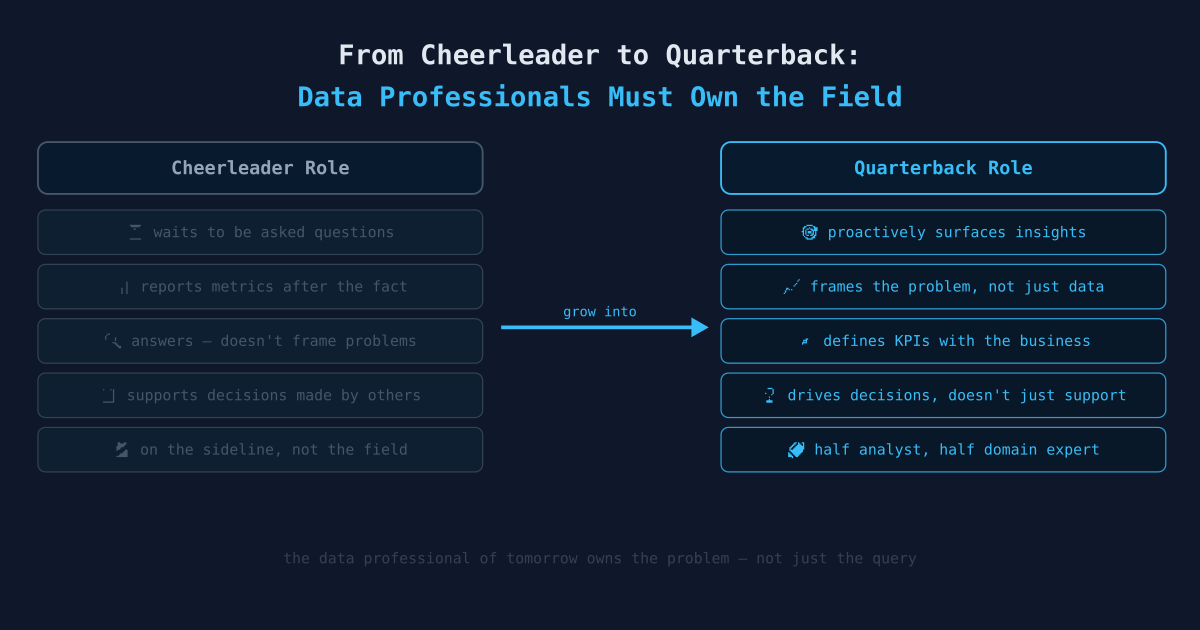
From Cheerleader to Quarterback: Why Data Professionals Must Be Half Subject Matter Expert
🌳 High Hanging Fruit
Every business has hired this version of the data professional at some point: technically competent, writes clean SQL, builds solid pipelines, produces a dashboard that presents well. The dashboards then sit unused. The recommendations get filed. The analyst is rarely looped into the decisions the work was meant to inform.
The problem is rarely the data. The problem is that this practitioner operates adjacent to the business rather than inside it — technically capable, but not positioned to influence the decisions the analysis was built to support.
The data professionals who drive measurable impact operate from a different position. They understand the operating model, the stakeholders, and the decisions being made. They participate in framing those decisions rather than reporting on them after the fact.
The Reactive Practitioner
The reactive data professional is often technically excellent. They know the tools, respond to requests, and deliver accurate analysis. The limitation is structural: their relationship to the business is external. The business asks a question; they answer it. A stakeholder requests a dashboard; they build it. A metric looks off; they investigate and report back.
This posture puts them downstream of every decision. They measure outcomes after the decisions have been made, but they are not in the room when the decisions get framed.
The pattern produces predictable complaints from within the role:
- Analysis gets produced but not acted on.
- Major business decisions are learned about through announcements.
- Leadership makes calls that the data appears to contradict.
- The work is almost entirely reactive — responding to requests rather than shaping which questions are worth asking.
The underlying cause is consistent: the practitioner does not understand the business well enough to be trusted with a seat at the table where decisions are framed.
The Embedded Practitioner
The embedded data professional operates inside the business rather than alongside it. They understand how revenue is generated, what each stakeholder is accountable for, what the current operational constraints are, and which prior initiatives have worked or failed.
From that position, the work shifts. They have enough domain knowledge to identify which questions are worth asking, which metrics actually influence outcomes, and which recommendations will be actionable versus politely acknowledged and shelved.
The embedded data professional:
- Anticipates analytical needs before requests are made
- Reframes poorly-scoped questions into ones that can be usefully answered
- Knows which stakeholders are accountable for which outcomes and communicates in terms of those outcomes
- Understands the operational constraints that determine whether a recommendation is viable
- Builds credibility through demonstrated understanding of the business, not just technical execution
This position is not earned through a new programming language or certification. It is earned by investing in domain knowledge — the business model, the competitive dynamics, the stakeholders, the decision history, and the failures that inform how the organization actually operates.
The Half Principle
The goal is not to become a full subject matter expert. A data professional who goes fully native in the domain risks losing the analytical distance that makes their perspective valuable. You still need to be able to see the patterns across the data, challenge assumptions, and ask the uncomfortable questions that insiders stop asking because they have normalized the way things work.
The sweet spot is half. Enough domain expertise to be credible, useful, and trusted. Enough analytical independence to provide genuine insight rather than just confirming what people already believe.
Half subject matter expert means:
- You understand the vocabulary of the domain well enough that experts do not have to slow down to explain basic concepts when they talk to you
- You know the key drivers — what moves the numbers, what is noise, what is a signal
- You can construct a hypothesis before looking at the data, and know what would confirm or disconfirm it
- You understand the incentive structures well enough to know why stakeholders are asking what they are asking
- You can spot when the business is confusing correlation with causation because you understand the actual mechanics
Half subject matter expert does not mean you need to have worked in that domain for a decade. It means you invest deliberately in domain learning as a professional discipline — not just technical skills.
How Domain Expertise Develops in Practice
Nobody starts embedded. When joining a new company, industry, or team, domain knowledge starts at zero. A reactive posture is the appropriate starting point while the learning happens.
The mistake is staying there indefinitely.
The transition is gradual and requires intentional investment in the domain, not just in technical skills.
Year one: Learn the vocabulary. Understand what the business actually does. Map the data to real-world operations. Find out what decisions are being made and which metrics executives actually track in their heads versus which ones they only look at in quarterly reviews. Start building relationships with the domain experts.
Year two: Start developing opinions. You have seen enough patterns to form hypotheses. You know which metrics are leading indicators and which are lagging. You start showing up to conversations with questions rather than just answers. You begin to anticipate what stakeholders will care about.
Year three and beyond: You have context. You remember when the business tried the same thing three years ago and why it failed. You know which stakeholder is going to push back on which recommendation. You have earned the credibility to say “I think we are asking the wrong question” — and have people listen.
That credibility is not transferable. It is domain-specific and earned through time and investment.
Reactive trajectory:
  Join team → Learn tools → Answer requests → Report results
  → Repeat indefinitely → Plateau or leave without clear attributable impact

Embedded trajectory:
  Join team → Learn tools + domain simultaneously → Build
  domain fluency → Form defensible opinions → Shape analytical
  priorities → Get invited into decisions earlier → Deliver
  measurable business outcomes → Expand scope
The Domain Learning That Actually Works
Most data professionals develop their technical skills intentionally — they read documentation, take courses, build side projects. Very few develop their domain knowledge with the same discipline. They absorb it passively, if at all.
Passive domain absorption sounds like: “I pick things up from stakeholder conversations.” The problem is that conversations with stakeholders mostly teach you what they think you need to know to do the job they already understand. It does not teach you the things that would let you reframe the job.
Active domain learning looks different:
Read what the domain reads. If you work in healthcare, read what healthcare operators read — trade publications, regulatory commentary, industry reports. If you work in retail, understand supply chain economics, merchandising strategy, and customer lifetime value modeling from the operator’s perspective, not just the data perspective.
Spend time with the operators. Ask to shadow a sales call, sit in on a customer support queue, walk the warehouse floor, watch an underwriter review an application. Seeing the work that generates the data changes how you interpret the data. The outliers make sense differently when you have watched a human being enter the records.
Learn the business model at a mechanical level. Understand exactly how money is made and lost. What does it cost to acquire a customer? What drives retention? What is the unit economics of the core offering? Data professionals who can reason about economics from first principles can connect their work to outcomes in ways that purely technical practitioners cannot.
Build hypotheses before looking at the data. Before you pull the query, write down what you expect to find and why. This forces you to reason from domain knowledge rather than just from what the data shows. The gaps between your prediction and the result are where the most interesting learning happens.
Treat domain experts as partners, not clients. A reactive practitioner treats domain experts as the people who assign work. An embedded practitioner treats them as collaborators who hold information the analysis depends on, and offers analytical capabilities they do not have. That is a peer relationship, not a service relationship.
The Counterargument Worth Taking Seriously
Some data professionals resist this framing on principled grounds: “My value is in being domain-agnostic. I can apply rigorous analysis to any problem without the biases that come from deep domain immersion.”
This is not wrong. There is genuine value in an outside perspective. Domain experts often cannot see structural problems that are obvious to an outsider. Statistical fluency that cuts across domains has real advantages.
But this argument is often used to justify not investing in domain knowledge at all — which is a mistake. The choice is not between full domain immersion and total domain agnosticism. It is about where on the spectrum you position yourself.
The purely domain-agnostic analyst has high ceilings in some contexts — academia, consulting engagements, cross-functional research — where the assignment changes frequently and domain-specific credibility is less important than methodological rigor.
For the practitioner embedded in a business — driving ongoing decisions, working with the same stakeholders, trying to actually change outcomes — the domain-agnostic posture tends to produce work that is technically sophisticated and practically inert.
A reactive practitioner may be producing excellent analysis. If nobody trusts that analysis enough to act on it, the technical quality does not translate into business impact.
Indicators of Position
The simplest diagnostic: Are you involved before the question is formed, or only after?
A reactive practitioner is handed questions. An embedded practitioner helps determine which questions are worth asking.
When major business decisions are routinely learned about through the announcement, the position is reactive. When stakeholders arrive with problems before they know what question to ask, the position is embedded.
Additional indicators:
| Reactive | Embedded |
|---|---|
| Responds to requests | Shapes what gets requested |
| Explains what happened | Predicts what will happen |
| Answers the question as asked | Reframes questions when necessary |
| Reports to the business | Partners with the business |
| Earns trust with accuracy | Earns trust with judgment |
| Understands the tools | Understands the domain |
Neither column is inherently bad. Accuracy and technical rigor remain prerequisites in both positions. The columns represent different centers of gravity — and most data professionals who are frustrated with the impact of their work are sitting too far left.
The Low Hanging Fruit
For most data professionals frustrated with the impact of their work, the constraint is not technical skill. It is domain fluency.
Pick one domain — the current industry, the company’s business model, or a specific function being supported — and invest in it with the same discipline applied to technical skills. Read what operators read. Spend time with the people who generate the data. Build hypotheses. Form defensible opinions. Predict outcomes before looking at the data.
Domain expertise built in one organization does not transfer perfectly to the next. The habit of investing in domain expertise does. Data professionals who develop that habit consistently outperform technically-equivalent peers, because they earn the trust that positions them to influence decisions rather than report on them.
Half subject matter expert is not a consolation prize. It is the specific combination — technical rigor plus domain fluency — that produces analysis the business acts on.
Related Articles
- Data Careers Are Not Pokemon Evolutions — Why role titles are a poor proxy for career trajectory, and what actually drives growth.
- Not Everyone Is a Data Analyst — The deliverable side of the same insight: designing for the audience’s decision, not the analyst’s curiosity.
- Low Hanging Fruit Reduces Risk and Builds the Expertise to Climb Higher — The strategy for building domain fluency through consistent, small-scale delivery.