Contents
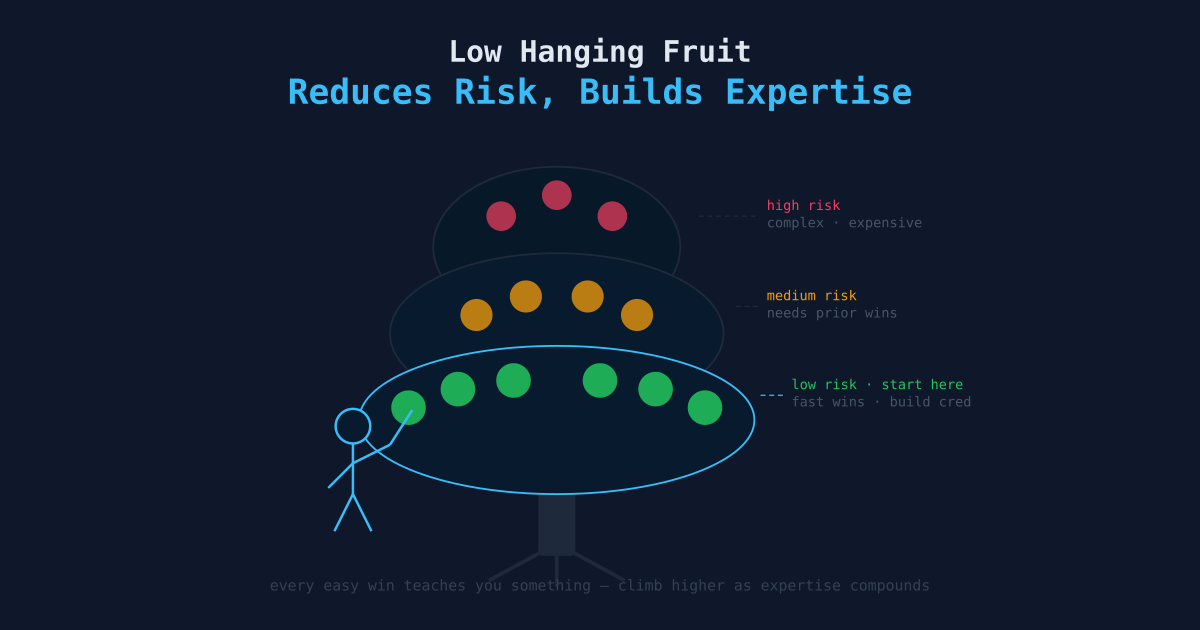
Low Hanging Fruit Reduces Risk and Builds the Expertise to Climb Higher
🍎 Low Hanging Fruit
A common failure pattern in data analytics is starting with sophisticated, high-impact work rather than building toward it: the multi-year predictive model, the enterprise-wide attribution framework, the real-time anomaly detection system — initiatives positioned as the moment data becomes a strategic asset.
These are legitimate end goals. They are poor starting points.
The data professionals and teams that consistently deliver measurable impact — and build the credibility to keep delivering it — almost always start with smaller work. The reason is structural: the failure mode of analytical work is rarely analytical. It is contextual. Analysis lands in the wrong decision window, delivered to stakeholders who do not yet trust the analyst or understand the output.
Low-hanging fruit addresses that structural problem directly. The underlying risk math is straightforward.
The Risk Profile of High Hanging Fruit
High-hanging analytical work is risky for reasons that have nothing to do with the quality of the analysis itself.
Long feedback cycles. A six-month modeling project means six months before you find out whether your assumptions about the business were correct, whether the data supports the approach, and whether stakeholders actually want what you thought they wanted. The longer the cycle, the more expensive the course correction.
Dependency on domain knowledge you do not yet have. Sophisticated analytical work requires deep understanding of the business mechanics you’re modeling. Which variables actually drive the outcome? Which relationships are structural and which are noise? What are the operational constraints that make certain findings actionable and others irrelevant? You cannot answer these questions confidently without domain fluency — and domain fluency takes time to build.
Trust debt. Delivering a complex recommendation to stakeholders who have not yet seen you operate is a high-stakes transaction. They are being asked to make a significant decision based on work they cannot fully evaluate by someone whose judgment they have not yet verified. The more consequential the recommendation, the more trust it requires. If you have not made smaller deposits into that trust account first, you are asking for credit you have not earned.
Analytical assumptions that are hard to validate. Long-horizon, high-complexity projects require chains of assumptions. Each link is a place where the analysis can be wrong in ways that are difficult to detect until it is too late. Simpler projects have shorter assumption chains and faster feedback.
The result is that high-hanging analytical work has a bimodal outcome distribution: it occasionally produces transformational impact, and it frequently produces nothing — work that is technically impressive and practically inert.
The Risk Profile of Low Hanging Fruit
Low-hanging analytical work looks different across every risk dimension.
Fast feedback cycles. A two-week project to clean up a reporting discrepancy, automate a recurring report, or answer a specific operational question gives you feedback in days. You learn quickly whether your understanding of the data is correct, whether you are solving the right problem, and whether the stakeholder actually uses what you build.
Tolerance for imperfect domain knowledge. You do not need to deeply understand the business to fix a broken dashboard or help someone answer a straightforward data question. These projects are sized to your current level of domain knowledge. As your knowledge grows, the projects grow with it.
Low trust requirements. A stakeholder who has never worked with you will accept a simple, well-executed deliverable with very little prior credibility. That deliverable then becomes the foundation for the next ask. Trust compounds.
Short assumption chains. Simpler problems require fewer assumptions. When the assumptions are wrong, the problem is small and the correction is fast.
This does not mean low-hanging fruit is easy. A well-executed simple analysis still requires rigor, clear communication, and genuine understanding of what the stakeholder needs. The difference is that when something goes wrong — and something always goes wrong — the blast radius is small.
Why Domain Knowledge Cannot Be Shortcut
A durable principle in applied analytics: the gap in analytical work is almost never methodological. It is domain knowledge.
The failure modes are specific:
A model is technically sound but practically useless because it optimized for a metric the business does not actually act on. The analyst did not have that context.
An analysis contradicts a decision that was already made for reasons that were not documented or communicated. The analyst did not have that context either.
A recommendation is operationally impossible given constraints the analyst was unaware of. The business knew. The analyst did not.
None of these are analytical failures. They are domain knowledge failures. The only way to develop the required domain knowledge is accumulated exposure — observing how the business operates, identifying which questions matter and which do not, and building a mental model of the mechanics grounded in operational reality rather than the data alone.
Low-hanging fruit projects are domain knowledge acquisition in operational form. Each one surfaces information that is not available from outside: which outputs stakeholders actually use, which numbers they trust and which they discount, which drivers are real versus which are tracked but inert, what “good enough” means in this specific context.
A year of consistently delivering small, accurate, useful work accumulates more domain knowledge than any other approach. That domain knowledge is the precondition for high-hanging-fruit work to succeed.
Low hanging fruit accumulation:
  Small project → Domain learning + trust deposit
  Small project → Domain learning + trust deposit
  Small project → Domain learning + trust deposit
  → Sufficient domain fluency + relationship capital
  → High-hanging fruit becomes tractable

High hanging fruit attempt without foundation:
  Large project → Long build → Missed assumptions
  → Stakeholder skepticism → Analysis not acted on
  → Return to start with less credibility than before
Building Relationships with Subject Matter Experts
The highest-performing analysts are not distinguished by methodological sophistication. They are distinguished by the working relationships they have built with the operators closest to the business — the subject matter experts.
This matters because subject matter experts hold information that is not captured in any dataset: the operational context that explains an anomaly, the business reason behind a rule that shapes the data, the decision from three years ago that still shows up in current numbers, the metric that is tracked on paper but is not used when decisions get made.
Accessing that knowledge requires trust. Trust between an analyst and a subject matter expert is not built through methodological sophistication. It is built through demonstrated usefulness on specific, tractable problems.
The operational pattern: a subject matter expert has an unresolved question. The analyst treats it seriously, delivers an accurate and useful answer, and communicates in a way that respects the expert’s time and existing knowledge. No oversell. No unnecessary complexity.
After several such interactions, the dynamic shifts. The subject matter expert brings problems earlier in the decision cycle, shares context that previously would not have been offered, advocates for the analytical function in rooms the analyst is not in, and flags upcoming changes to the data before those changes take effect.
That relationship generates domain knowledge faster than any other mechanism. It also generates organizational credibility that is difficult to build any other way. Low-hanging fruit is the strategy for building these relationships: the analysis is the deliverable, but the demonstrated reliability is the asset.
Analytical Ambition as Risk Aversion
A specific failure mode is worth naming: analytical ambition that functions as risk aversion. A practitioner who is always working on the important project — the large model, the enterprise initiative — is rarely accountable for delivering anything small. The work is perpetually in progress. The impact is perpetually forthcoming.
This is a low-accountability position. The work appears important. The failure mode is invisible because large projects fail slowly. Meanwhile, the domain knowledge gap persists, stakeholder relationships remain thin, and the organization does not develop the trust in analytical work that would make high-hanging fruit tractable.
The higher-accountability position is committing to deliver small, useful, accurate work and being evaluated on it immediately. That accountability, accumulated over time, is what earns the opportunity to work on the larger initiatives.
What Low-Hanging Fruit Is Not
Low-hanging fruit is not the permanent strategy. It is the foundation.
The objective is not a career of answering one-off questions and cleaning up reports. The objective is building the domain knowledge, stakeholder trust, and subject matter expert relationships that make it possible to identify high-value analytical questions, secure organizational buy-in, and execute on those questions with the domain fluency the work requires.
That progression is not linear. A new role or new domain resets the clock on domain knowledge and relationships, even when technical skills transfer. Recognizing that reset and starting with smaller commitments is not a reduction in ambition. It is the efficient path to delivering higher-impact work earlier.
Analysts who skip this process produce work that is technically impressive and practically ignored. Analysts who follow it reach high-hanging fruit faster — because they approach it from a position of established credibility rather than projected ambition.
Related Articles
- Crawl, Walk, Run: Why Many Attempts Beat One Perfect Try — The engagement side of the same principle: why shipping imperfect work early beats waiting for perfect work.
- From Cheerleader to Quarterback: Why Data Professionals Must Be Half Subject Matter Expert — How domain expertise accumulates through exactly the kind of small, consistent delivery this article describes.
- Don’t Build Analytical Castles on Sand — What happens when high-hanging analytical work gets built on a foundation nobody fully understood.