Contents
Bronze, Silver, Gold: The Medallion Architecture Explained
🍎 Low Hanging Fruit
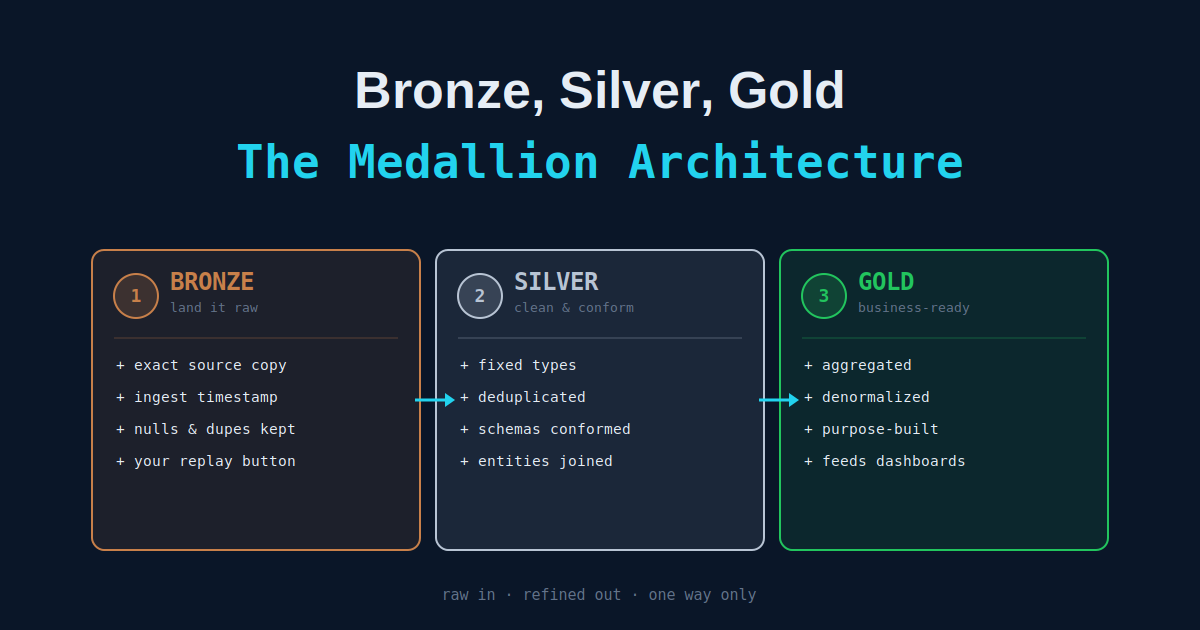
Most data pipelines fail in the same quiet way: raw data, half-cleaned data, and report-ready data all end up living in the same place, and nobody can tell which is which. Six months later you have a table called customers_final_v2_clean and no idea whether it is safe to trust. The medallion architecture exists to prevent exactly this. It splits your pipeline into three named layers — bronze, silver, and gold — where each layer has one job and each step forward makes the data more refined.
The metaphor is medals, not metals: bronze is the entry point, silver is better, gold is best. Data flows in one direction only.
Source → [ BRONZE ] → [ SILVER ] → [ GOLD ] → Dashboards / ML / Reports
          raw           cleaned      business-ready
Nothing here requires a specific tool. You can implement the medallion pattern in a cloud warehouse, in DuckDB on your laptop, or with three folders of Parquet files. The value is in the discipline, not the technology.
Bronze: Land It Raw, Change Nothing
The bronze layer is a faithful copy of the source. You extract data and write it down exactly as it arrived — same columns, same messy types, same duplicate rows, same nulls. The only things you are allowed to add are metadata: an ingestion timestamp, the source system name, maybe a batch ID.
The rule for bronze is simple: do not transform. Resist the urge to fix that obviously-wrong date column here. The moment you start cleaning in bronze, you lose your ability to answer the most important question in any pipeline: what did the source actually send us?
Why an untouched layer matters
- It is your replay button. When a downstream bug corrupts a report, you can rebuild everything from bronze without re-hitting the source API — which may be rate-limited, may have changed, or may no longer serve last month’s data at all.
- It is your audit trail. If a stakeholder insists the numbers are wrong, bronze is the evidence of what the source system said and when.
- It absorbs schema surprises. Sources add columns, rename fields, and change formats without warning. Bronze catches all of it unfiltered, so a schema change becomes a visible event instead of a silent data-loss bug.
Bronze is cheap storage and high trust in provenance, not in quality. Nobody should build a dashboard directly on bronze.
Silver: Clean, Conform, and Join
The silver layer is where the actual work happens. You take the raw bronze data and turn it into something correct and consistent:
- Fix types. Strings that should be dates become dates.
"1,200.00"becomes1200.00. - Handle nulls and duplicates. Deduplicate records, drop or flag rows that fail validation, standardize the fifteen different spellings of a country name.
- Conform schemas. Rename cryptic source columns (
cust_id_x) to consistent names (customer_id) so tables from different systems can be joined. - Enrich and join. Combine the orders table with the customers table, attach reference data, derive obvious fields like
order_total.
The result is a set of clean, well-typed, deduplicated tables that faithfully represent your business entities — customers, orders, events — without yet being shaped for any one report. Silver is the layer your data engineers and analysts actually query when they need trustworthy raw material.
The silver boundary
The trap in silver is doing too much. Silver should answer “is this data clean and correct?” — not “what is our monthly revenue by region?” Business-specific aggregations belong in gold. Keeping silver at the entity level means many different gold tables can be built from the same silver foundation without duplicating cleaning logic.
A good test: if two teams would clean the data the same way but aggregate it differently, the cleaning belongs in silver and the aggregation belongs in gold.
Gold: Shape It for the Consumer
The gold layer is built for a specific audience and a specific question. These are the tables that feed a dashboard, train a model, or land in an executive report. Gold tables are typically:
- Aggregated. Daily revenue by region, churn rate by cohort, average handle time by team.
- Denormalized. Joins are already done and flattened so a BI tool can read one wide table fast, without the consumer needing to understand the underlying schema.
- Purpose-built. A gold table for the finance dashboard and a gold table for the ML feature store may draw from the same silver tables but look completely different.
Because gold is derived entirely from silver, it is disposable. If a new metric definition arrives, you rewrite the gold table — you never touch bronze or silver. This is what makes the architecture resilient: the expensive, trustworthy layers stay stable while the presentation layer changes as often as the business needs it to.
Why Three Layers Beat One
You could technically load data and clean-and-aggregate it in a single step. Teams do it all the time, and it works right up until it doesn’t. The medallion split earns its keep in the moments that break single-step pipelines:
| Situation | One-step pipeline | Medallion |
|---|---|---|
| Source API changes format | Silent breakage, unclear where | Visible at bronze, isolated |
| A metric definition changes | Rewrite the whole pipeline | Rewrite one gold table |
| Report numbers are disputed | No record of source truth | Bronze is the receipt |
| A new team wants the same data shaped differently | Copy and fork the pipeline | Add a gold table on existing silver |
| A bug corrupts output | Re-extract from source | Replay from bronze |
The layers give every kind of change a single obvious home. That is the entire point: when something goes wrong, you know which layer to look in.
Common Mistakes
- Transforming in bronze. The most frequent and most damaging error. Once bronze is “helpfully” cleaned, you can never reconstruct what the source sent. Keep it raw.
- Business logic in silver. Revenue rules, KPI definitions, and audience-specific shaping leak upstream and force you to maintain the same logic in five places. Push them down to gold.
- Skipping silver. Going bronze-straight-to-gold feels faster until two dashboards disagree because each re-cleaned the raw data slightly differently. Silver is the shared source of clean truth.
- Treating gold as sacred. Gold tables are meant to be rewritten. If changing a metric feels scary, your business logic has probably crept into silver.
Where to Start
You do not need a data lakehouse to adopt this. On a small project, three schemas in the same database — bronze, silver, gold — is a complete, legitimate implementation. Land your raw extracts in bronze, build cleaned entity tables in silver, and let each dashboard own its gold table.
The medallion architecture is not a product you buy. It is a naming convention plus a rule about direction of flow: raw in, refined out, one way only. Adopt just that, and the next engineer who opens your project — including future you — will know exactly which table to trust and exactly where to make the next change.