Contents
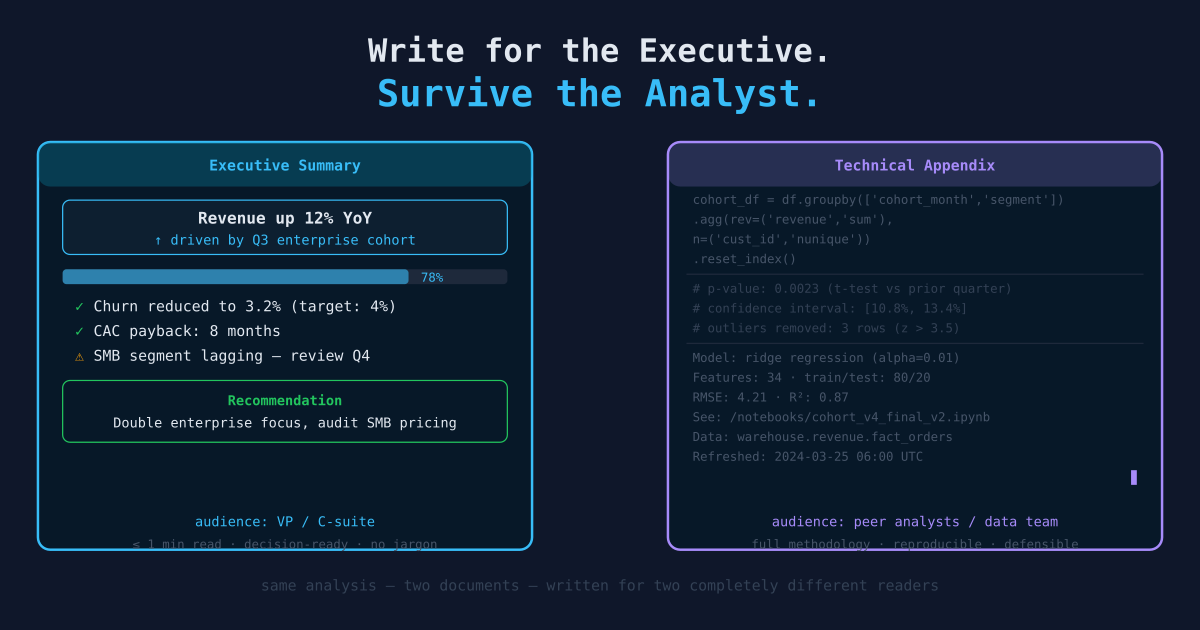
Write for the Executive. Survive the Analyst.
🍎 Low Hanging Fruit
One version of executive analysis gets read, acted on, and then dismantled by the team assigned to review it. The decision reverses. The analyst loses credibility. The initiative dies in a working group.
Another version gets read, acted on, and survives three days of senior analysts pressure-testing it — emerging with more organizational trust than it had on arrival.
The difference is not the recommendation. It is the structure.
How Executives Use Analysis
The standard framing of executive audiences emphasizes that they are busy, so the output should be simple. That framing is accurate but incomplete. The more consequential observation is that executives make fast decisions and then delegate the verification.
A capable executive can read a one-page brief, decide within minutes whether the direction is right, and then hand it to their team with the instruction: “Find out if this holds up.” The team is not being asked to make the decision. They are being asked to determine whether the decision is defensible.
This creates a two-audience problem. The analysis must work for both:
Audience 1: The executive
  Time available:    3 minutes
  What they need:    One clear recommendation with the key number
  How they read:     Top down. First sentence. Table. Conclusion.
  What kills it:     Buried lead. Hedged recommendations. Walls of text.

Audience 2: The team sent to review it
  Time available:    3 days
  What they need:    Methodology, data sources, assumptions, edge cases
  How they read:     Bottom up. Appendices first. Challenge every number.
  What kills it:     Missing denominator. Undefined time window. Cherry-picked range.
Most analysis is built for one audience or the other. Either a crisp slide deck with no supporting detail, or a thorough technical report with no usable summary. The first fails review. The second is not read. Analysis that drives decisions and survives scrutiny serves both.
The Anatomy of Executive-Ready Analysis
The structure is not complicated, but it requires discipline:
The recommendation comes first. Not the methodology. Not the data. The recommendation. The executive needs to know within ten seconds what you are asking them to do or decide. Everything after that is support.
One number anchors the recommendation. Not seven numbers. One. The number that, if wrong, changes the recommendation. If you cannot identify that number, you have not finished the analysis.
The key assumption is visible. Every recommendation rests on at least one assumption that could be wrong. Name it explicitly. “This holds if churn stays below 8%. If it exceeds 8%, the ROI inverts.” The executive needs to know the condition under which the recommendation breaks.
The detail is accessible but not in the way. Supporting data, methodology, and sensitivity analysis go in an appendix, a backup deck, or a linked document. The team will find it. The executive should not have to wade through it.
Wrong structure:
  Background (3 pages) → Methodology (2 pages) → Findings (4 pages)
  → Limitations (1 page) → Recommendation (1 paragraph)

Right structure:
  Recommendation (1 sentence) → Key number (1 line)
  → Condition under which this breaks (1 sentence)
  → Three supporting points (1 paragraph each)
  → Everything else (appendix)
This is not a trick. It is a commitment to doing the analysis completely enough that you can collapse it to a single defensible sentence.
Why Consequential Analysis Gets Examined
Most analysis is never scrutinized. It is acknowledged, filed, and ignored. The recommendations remain in slide decks. Nothing changes.
The analysis that drives action is the analysis that gets interrogated.
When an executive is going to commit budget, restructure a team, exit a market, or change pricing based on an analysis, they send someone to verify it. The magnitude of the action determines the depth of the review. Consequential analysis produces consequential scrutiny.
The analysis that most requires rigor is the analysis most likely to be acted on. The stakes and the review depth are correlated.
| Recommendation Size | Likely Review | What Breaks It |
|---|---|---|
| Small operational change | Quick sanity check | Obvious error in math |
| Reallocation of budget | Senior analyst review | Inconsistent time windows |
| Major strategic decision | Cross-functional audit | Undefined methodology |
| Board-level commitment | External validation | Survivorship bias, selection effects |
Analysis that only survives a quick sanity check can only support small decisions.
What the Team Will Look For
When an executive’s team receives analysis to review, they are running through a checklist, whether they call it that or not. The items are consistent across industries and functions:
Is the denominator correct? More analysis fails here than anywhere else. A conversion rate of 12% looks different if the denominator is total visitors, qualified leads, or only leads that saw the offer. The number means nothing without the denominator, and a wrong denominator can flip the direction of a finding.
What is the time window, and is it representative? A metric that is “up 40%” needs a defined start and end. Three months that were chosen because they looked good is not analysis. The team will ask: what happens if you extend the window? What happens if you shift it back six months?
What was excluded, and why? Every data set has outliers, edge cases, and records that did not make it into the final analysis. The team wants to know what got dropped. “Removed records with null values” is not a complete answer if 18% of the records had null values.
What would have to be true for this to be wrong? This is the most important question and the one that most analysts dodge. A good sensitivity analysis identifies the variables that most affect the conclusion and shows what happens when those variables move. If the recommendation only holds in a narrow band of assumptions, the executive needs to know that.
Can I reproduce this? If the analyst is not available, can the team reconstruct the output from the description of the methodology? If not, the analysis is not complete.
The Discipline of One Number
One of the harder skills in executive communication is choosing the single number that carries the analysis.
The default instinct is to show everything. The work produced twelve useful findings, so all twelve seem worth presenting. Twelve numbers, however, do not deliver twelve times the clarity — they deliver one-twelfth the signal with twelve times the noise.
The discipline of one number is not simplification. It is identifying the load-bearing fact — the number that, if the executive understood nothing else, would still point the decision in the correct direction.
Weak executive summary:
  "Revenue is up 14%, driven by a 9% increase in average order value
   and a 6% improvement in conversion rate, offset by a 4% decline in
   new user acquisition and a slight increase in refund rates..."

Strong executive summary:
  "Net revenue per user is up 11% year over year. That is the number
   that matters. Everything else is attribution."
The weak version is not wrong. Every number in it might be accurate. But the executive cannot act on it because there is no clear signal. The strong version gives the executive something to stake a decision on — and gives the review team a clear target to verify or challenge.
The Most Common Ways This Breaks Down
The buried lead. The most important finding is in paragraph four. The executive reads paragraph one, forms a wrong impression, and acts on it. By the time the review team gets there, the decision is made. Put the recommendation first. Every time.
The hedge that is not a hedge. “We believe, with moderate confidence, that this approach will likely produce results consistent with our projections, assuming conditions remain roughly similar.” This sentence communicates nothing. If there is genuine uncertainty, quantify it: “If acquisition cost rises above $42, this investment breaks even rather than producing a return.”
The number that cannot be found. The executive cites a figure from the analysis in a meeting. A team member asks where it came from. Nobody can find it in the document. This ends credibility immediately. Every number in the summary must trace directly to a source in the detail.
The missing comparison. “Sales are up 8%” means nothing without context. Up 8% versus what? The prior period? The plan? The industry? A number without a comparison is not a finding.
The sensitivity that was not done. The recommendation is based on projected customer lifetime value of $180. The team reviewer asks: what happens at $140? If you do not have an answer prepared, the review will pause the entire initiative while someone finds out.
What This Requires from the Analyst
Building analysis that is simple for the executive and defensible under review is more work than building either alone. The analyst must complete the full technical work and the additional work of collapsing it without losing the load-bearing structure.
This is the same discipline required to build a gas gauge on a dashboard. The output is simple; the simplicity is earned by the work behind it. The needle means something because the threshold is defensible. Remove the work and the output is a needle pointed at an arbitrary number.
Analysts who produce executive-ready work apply a specific practice: after completing the analysis, they attempt to break it before the reviewer does.
The questions:
- What is the weakest assumption in this recommendation?
- What is the most obvious objection a skeptic would raise?
- If one input changes by 20%, does the conclusion hold?
- Can every number in the summary be defended in three sentences or fewer?
If those questions cannot be answered, the output is a briefing, not a complete analysis. A briefing gets acknowledged. An analysis that withstands review gets acted on.
The Low Hanging Fruit
For the next executive-facing analysis: write the recommendation first, in a single sentence. Identify the one number that supports it. Name the assumption under which it breaks. Move everything else to an appendix.
Then hand the appendix to the most skeptical available reviewer and ask them to break the summary. If they identify something, fix it before the analysis goes up. If they cannot, the analysis is ready for executive review.
Executives make fast decisions. Their teams take their time. The work that drives sustained action is the work that is built to serve both audiences — simple enough to drive a decision, rigorous enough to hold up under verification.
Related Articles
- Not Everyone Is a Data Analyst — The audience side of the same principle: designing deliverables for decision-makers, not analysts.
- The Gas Gauge Is the Hardest Chart to Build — How the discipline of defining thresholds produces the same kind of earned simplicity this article describes.
- From Cheerleader to Quarterback: Why Data Professionals Must Be Half Subject Matter Expert — The domain fluency required to produce executive-ready analysis that holds up under review.