Contents
KPIs Are a Cultural Change, Not a Dashboard Project
🍎 Low Hanging Fruit
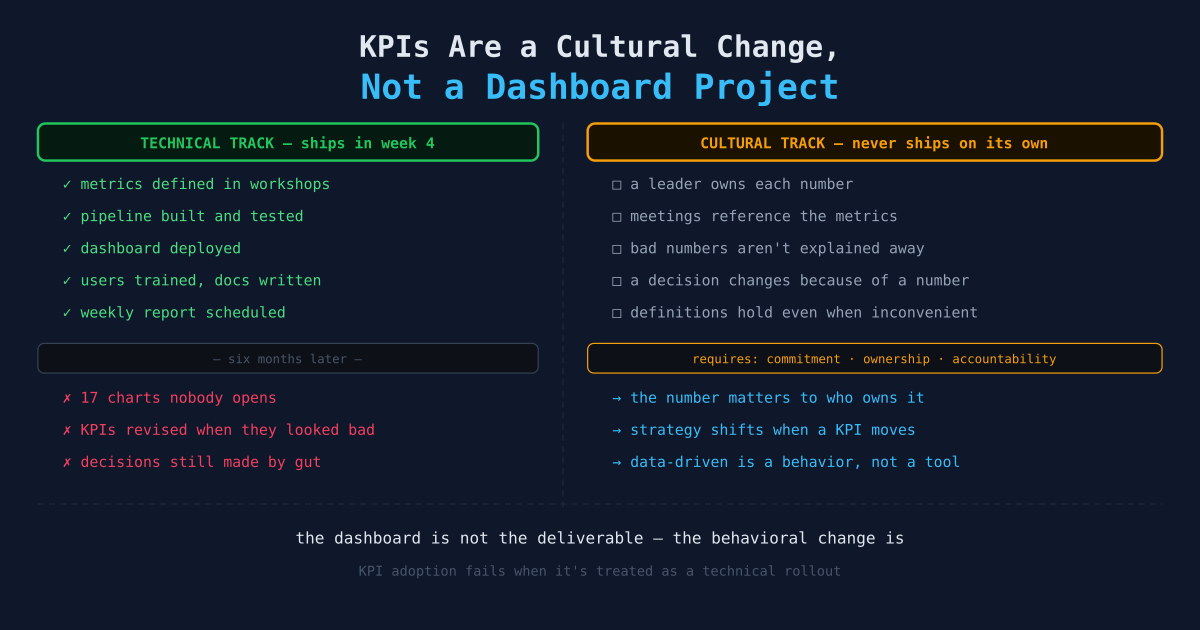
Every year, organizations launch KPI initiatives with genuine enthusiasm. A consultant comes in, or a new VP of Operations arrives, or someone reads a book about OKRs. Workshops happen. Metrics are defined. A dashboard gets built. Everyone agrees that the organization is now “data-driven.”
Six months later, the dashboard has seventeen charts no one looks at, three KPIs that keep getting revised because they look bad, and a leadership team that still makes decisions the same way they always did — by gut, by relationship, and by whoever talked last in the meeting.
The initiative failed. But it did not fail because the metrics were wrong, or because the dashboard was hard to use, or because the data quality was poor. It failed because nobody changed how decisions get made.
The Real Barrier Is Behavioral, Not Technical
A KPI is not a number on a screen. A KPI is a commitment: this is the measure by which we will evaluate success, and we will make decisions accordingly.
The technical part — pulling the data, building the pipeline, populating the dashboard — is the easy part. The hard part is getting the people who control resources, headcount, and strategy to say: “I looked at this number, and it changed what I did.”
That is a behavioral change. Behavioral change in organizations is hard. It requires people to give up comfortable habits — the subjective judgment calls, the political calculations, the instincts built over years — and replace them with a process that is more transparent, more auditable, and often more uncomfortable. It requires accepting that a metric might tell you something you do not want to hear, and that you will act on it anyway.
Most organizations do not do this. They adopt the vocabulary of data-driven decision making without adopting the practice.
What organizations say:   "We're committed to data-driven decisions."
What organizations do:    Use data to support decisions already made.
                          Revisit metrics when results are inconvenient.
                          Ignore dashboards when they contradict intuition.
                          Continue promoting managers who hit targets by
                          shifting goalposts rather than improving outcomes.
Data for the Sake of Data
When KPIs exist without behavioral commitment, they become data for the sake of data. Reports get generated. Numbers get reviewed in weekly meetings. Charts go into board presentations. And none of it changes anything.
This is expensive. It consumes engineering time, analyst time, and leadership attention. It creates the illusion of rigor without the substance. And it tends to calcify — dashboards that no one acts on keep getting maintained because removing them would require admitting the project did not work.
The waste is not just financial. It is organizational. Teams that spend time building and maintaining metrics that no one uses learn a lesson: data work here does not matter. Analysts become cynical. Data engineers build pipelines for reports that get downloaded once. The data culture does not grow — it becomes a performance of data culture, with all the props and none of the impact.
The distinguishing question is simple: Can you name a decision that was made differently because of this KPI?
If the answer is consistently no — if the metrics are reviewed but never drive action — then the organization has data infrastructure without data culture. The pipeline is not the problem.
The Moving Yardstick
The more damaging failure mode is not ignoring KPIs. It is gaming them.
A KPI that becomes inconvenient will be revised. The target was too aggressive. The metric does not capture the full picture. There were extenuating circumstances this quarter. Maybe we should measure it differently going forward.
Sometimes those arguments are valid. Metrics should evolve as the business evolves. But there is a meaningful difference between updating a metric because you learned something and updating it because the number looks bad.
When people in an organization learn that KPIs get revised when they fail, they stop treating KPIs as commitments. They treat them as aspirational statements that are subject to negotiation. The metric becomes a moving yardstick: not a fixed standard against which performance is measured, but a standard that adjusts to meet wherever performance landed.
Fixed yardstick (healthy):
  Target: 85% customer satisfaction
  Result: 79%
  Response: "We missed the target. Here's why, and here's the plan."

Moving yardstick (dysfunctional):
  Target: 85% customer satisfaction
  Result: 79%
  Response: "The survey methodology was flawed. Also, 79% is actually
             good for our segment. Let's revisit the target for next quarter.
             We'll adjust to 80% and refine the measurement approach."
  Next quarter target: 80%
  Next quarter result: 76%
  Response: "Customers are going through a tough period generally..."
The moving yardstick destroys KPI credibility faster than any data quality issue. Once teams understand that targets shift when missed, the only rational response is to stop trusting the targets — and stop trusting the process that produces them.
What Genuine Commitment Looks Like
A KPI program that works looks different from the surface-level version in specific, observable ways.
Decisions are documented against metrics. When a budget decision is made, the rationale references the relevant KPI. When headcount is approved or denied, the KPI that supports the case is cited. There is a paper trail connecting data to decisions.
Bad numbers are not buried. When a KPI is red, leadership says it is red, explains why, and commits to a response. The response is tracked. If the response does not work, that is also stated plainly. Organizations with genuine data culture do not hide from unflattering numbers — they treat them as information.
Targets do not change retroactively. If a target needs to be revised, it is revised before the period starts, with documented reasoning, and with acknowledgment of what the prior miss meant. Revisions happen rarely and transparently, not silently after the quarter closes.
The people accountable for metrics have the authority to move them. This one is underrated. A KPI that a manager owns but cannot directly influence is not a management tool — it is a punishment mechanism. Real KPI accountability requires that the person responsible for the number controls the levers that move it. When accountability and authority are misaligned, people either game the metric or disengage from it.
Leaders model the behavior. The most powerful signal in any cultural change is what leadership actually does. If the CEO reviews the dashboard weekly and asks hard questions about red metrics, the rest of the organization learns that data matters. If the CEO uses data only when it’s favorable, the organization learns the opposite — and learns it immediately.
Why This Is a Leadership Problem
Data teams often frame failed KPI initiatives as measurement problems. The wrong metrics were chosen. The data was messy. The dashboards were not intuitive enough. These are real problems and worth solving.
But the root cause of most KPI failures is not technical. It is that the leaders who sponsored the initiative did not actually commit to changing how they make decisions. They wanted the credibility of being data-driven without the constraints that come with it.
A metric-based culture requires leaders to be wrong in public. When a KPI shows that a strategy is not working, the leader who owns that strategy has to acknowledge it, act on it, and be accountable for the response — all on record. That is genuinely hard. It is a different kind of leadership than the kind that thrives on ambiguity and the ability to reframe results after the fact.
Organizations that successfully make this shift usually have a senior leader who drives it and who personally demonstrates what acting on data looks like. The metrics, the dashboards, the data infrastructure — those all follow from that commitment. They do not create it.
| Initiative Type | Where It Starts | What It Produces |
|---|---|---|
| Cosmetic data-driven | Dashboard project, analytics hire | Reports, meetings, terminology change |
| Genuine data-driven | Leadership commitment to act on data | Decision trail, accountability, behavior change |
How to Assess Where You Are
If you are trying to evaluate whether your organization’s KPI program is genuine or cosmetic, the questions are not about the data:
- In the last six months, which decisions were reversed or changed because of a KPI? If you cannot name one, data is not driving decisions.
- When a KPI misses its target, what happens? If the answer is “we discuss it” rather than “someone owns a response and reports back on it,” the accountability is missing.
- When was the last time a target was revised after a miss? If the answer is “last quarter,” ask whether the revision was driven by new information or by the miss itself.
- Do the people accountable for KPIs have the authority to move them? If not, the accountability structure is broken.
- When did a leader last say, in a meeting, “the data says we were wrong about this”? If no one can remember, the culture is not there yet.
These questions are uncomfortable. That is the point. A genuine data-driven culture is not comfortable — it is rigorous. It requires people at every level to be honest about what the numbers show, even when the numbers are inconvenient.
The Low Hanging Fruit
The lowest-cost, highest-impact thing a leadership team can do to actually build a data-driven culture is this: pick one KPI, commit to it publicly, and refuse to move the target when the number looks bad.
Not seventeen KPIs. One. Make it something that matters, something the team controls, and something that will be reviewed in every leadership meeting for the next twelve months. When it is red, say it is red. When it is green, explain why. When the team asks to revise the target, push back — hard — and require documented justification tied to new information, not just a bad result.
Do that for a year, and the organization will start to believe that the data matters. Do it across two or three cycles, and people will start bringing data to decisions proactively, because they will have seen that data drives outcomes.
Build the dashboard first, and none of that happens automatically. Build the culture first — even imperfectly — and the dashboard becomes useful.
KPIs are not a reporting project. They are a commitment to a way of making decisions. Until the organization makes that commitment, the charts are just decoration.
Related Articles
- The Gas Gauge Is the Hardest Chart to Build — The technical and organizational discipline of defining what “good” looks like for a metric.
- Dashboards Are Waiting Rooms: Interconnectivity Is the Endgame — The next maturity stage after KPI adoption: automating the actions that dashboards currently trigger.
- Not Everyone Is a Data Analyst — Designing KPI deliverables for the decision-makers who need to act on them, not the analysts who built them.